
Our method is based on the laws of probability. The primary objective is to manage your bankroll efficiently through even-money outside bets of equal value (such as Red/Black or Even/Odd).
As we have previously stated, roulette has no memory, but statistical sequences follow strict mathematical guidelines. By understanding the math behind a sequence of spins, you can optimize and measure your short-term risk management.
How Does the Method Work in Practice?
The system operates in quick, cyclical phases designed to protect your capital and guarantee a profit whenever a cycle is successfully closed.
If you win: Collect your profit. Switch to the opposite color (Red), reset your bet back to the initial 1 unit, and return to Phase 2.
If you lose: Stay on the same color (Black), but double the value of your previous bet (2 units) to enter the recovery phase.
In Summary:
This logic ensures that, regardless of when the losing streak ends, the final winning bet covers all accumulated losses from that cycle and secures exactly 1 unit of net profit.
Mathematical Breakdown
European and French Roulette wheels feature 37 pockets:
If we choose to bet on Black, the raw probabilities per spin are:
Consecutive Losing Streaks
The main concern for players applying this geometric progression method is the risk of experiencing a long streak of consecutive losses that could deplete their bankroll or hit the table’s maximum betting limit.
Let’s simulate a standard, real-world casino table scenario with a minimum bet of 1 unit and a maximum table limit of 1,000 units:
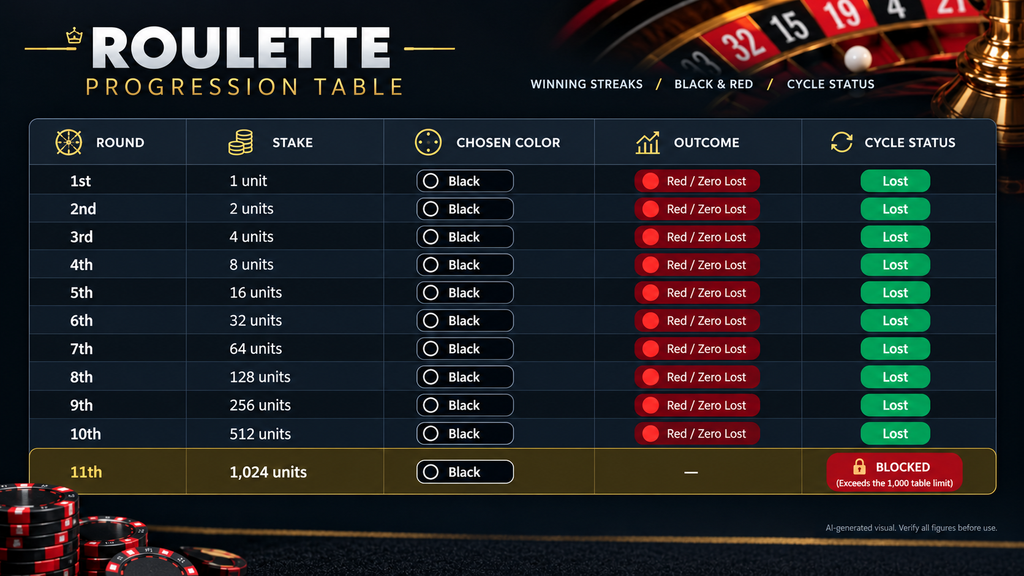
On the 11th bet, the system breaks because the table limit prevents the progression and stops you from doubling your stake once more.
However, what are the mathematical odds of the casino aligning 11 consecutive losses before you secure a single win?
Probability of losing 11 times in a row = = (19/37)^11 = 0,0006547 = 0,065%
What This Means Statistically:
In 1,526 times out of every 1,527 sessions, the progression successfully concludes within ten rounds, protecting your capital and securing at least one unit of profit.
Once every 1,527 sessions, you may face the absolute worst-case scenario, which is losing the total accumulated amount across the progression steps.
The method is not infallible, but it is highly efficient for securing consistent short-term outcomes.
Essentially, this system gives you ten consecutive opportunities to land a single winning round.
The green Zero counts as a standard loss for Even-Money bets (Red/Black). If it hits, you must treat it exactly like landing on the wrong color: stay on your chosen color and double your previous stake for the next spin. The method’s math already factors the Zero into the 51.35% house edge.
Mathematically, because roulette is a memoryless game, alternating colors or staying on the same color yields the exact same 48.65% probability on the next spin. However, alternating colors is highly recommended to break cognitive bias (the psychological urge to guess trends) and to maintain a strict, mechanical discipline without emotional interference.
You can, but it drastically reduces your safety margin. If you start at $10 on a table with a $1,000 maximum limit, your progression breaks at the 8th step ($10 → $20 → $40 → $80 → $160 → $320 → $640 → Blocked at $1,280). Starting with 1 unit ensures you get the full 10 recovery opportunities.
If your internet drops or the software freezes while you are on a high step (e.g., $128), log back in immediately and check your game history. If the bet was lost, continue the progression from the next logical step ($256). The mathematical probability of the sequence does not reset just because the connection was interrupted.
American Roulette features two house pockets: the 0 and the 00 (double zero). This shifts the losing probability from 19/37 (51.35%) to 20/38 (52.63%). While a 1.28% difference sounds small, when compounded over an 11-step geometric sequence, it nearly doubles your risk of hitting a total table wipeout. Always stick to European or French wheels.